
The United States Citizenship and Immigration Services (USCIS) has reinstated officers' authority to deny immigration benefit requests if applicants submit incomplete applications or fail to provide necessary documentation. This new policy, effective immediately, reverses a previous rule that allowed a 12-week response period for requests for evidence, placing the burden squarely on applicants to prove eligibility at the time of filing.

The Trump administration has reinstated and expanded the "public charge" rule, making it harder for immigrants seeking green cards if they have used public benefits like Medicaid, food stamps, or housing assistance. This policy change, effective September 18, will impact many applicants, including those from India, by broadening the criteria for inadmissibility.

The US Citizenship and Immigration Services (USCIS) is updating Form I-485 for permanent residence, effective September 18, 2026, with no grace period for older versions. This change, aligning with public-charge inadmissibility rules, significantly impacts Green Card applicants, particularly Indian nationals facing visa backlogs, who must use the correct form version to avoid rejection.
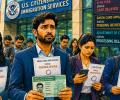
This could come as a setback to thousands of Indian engineers who have waited for years for their work visas to pave the way for the coveted Green Card.

With the duration of stay capped at four years, the biggest impact of the new F-1 visa rules is likely to be on PhD scholars, students enrolled in longer professional programmes, those whose graduation gets delayed and students moving from one academic programme to another, highlight education experts.

A deep dive into Trump's new policy and what it means for Indian professionals and companies.
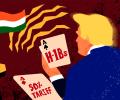
The US government will fight lawsuits aimed at blocking the USD 100,000 fee imposed on new H-1B visa petitions, asserting that the system was spammed with fraud and must be overhauled to prioritise American workers.

Trump to sign order creating Olympics task force ahead of 2028 games
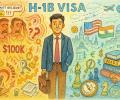
'You are a guest in the US. It's not your home, you're a guest. If they don't feel comfortable, you have to step out.'

Amid mass layoffs in the tech sector, the federal agency for immigration services has said it is wrong to assume that sacked workers holding the much-sought-after H-1B visas have to leave the country within 60 days, asserting they have multiple options to stay in the US. The H-1B visa is a non-immigrant visa that allows US companies to employ foreign workers in speciality occupations that require theoretical or technical expertise. Technology companies depend on it to hire tens of thousands of employees each year from countries like India and China.
'Of course, people will have to carry documents all the time. There is overall uncertainty in living in the US.'
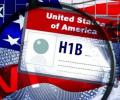
In yet another immigration-friendly move that would benefit thousands of Indian-American women, the Biden administration has agreed to provide automatic work authorisation permits to the spouses of H-1B visa holders, most of whom are Indian IT professionals.

This provides for H-1B extensions beyond the 6-year limit.

The Biden administration has announced that it is delaying the H-1B policy of the previous Trump administration on allocation of the popular foreign work visas by continuing with the lottery system until December 31, 2021, to give the immigration agency more time to develop, test and implement the modifications to the registration system. On January 7, the US Citizenship and Immigration Services (USCIS) announced to do away with the traditional lottery system in deciding the successful applicants for the H-1B visas. The H-1B visa is a non-immigrant visa that allows US companies to employ foreign workers in specialty occupations that require theoretical or technical expertise.
The US has received enough petitions needed to reach the Congressionally-mandated 65,000 H-1B visa cap for the fiscal year 2021 and successful candidates for the most sought-after work visa among foreign professionals, including Indians, would be decided by a computerised draw of lots. The H-1B visa is a non-immigrant visa that allows the US companies to employ foreign workers in speciality occupations that require theoretical or technical expertise. The technology companies depend on it to hire tens of thousands of employees each year from countries like India and China.

Rescinding its more than 13-year-old policy, the US Citizenship and Immigration Services has said that the burden of proof in establishing eligibility is, at all times, on the petitioner.
Two US lawmakers have introduced a bill in the House of Representatives that aims at granting an automatic right to H-4 visa holders to work in the country, a move which will benefit the spouses of thousands of foreigners, including Indians, and also address the labour shortage affecting American businesses. H-4 visas are issued to dependent spouses and children who accompany H-1B, H-2A, H-2B, and H-3 visa holders to the United States. Many H-4 visa holders are highly skilled people in their own right and previously had careers of their own or worked to support their families.

The changes if legalised would have a detrimental effect on the functioning of Indian tech companies in the US and also small and medium-sized contractual farms in the IT sector, which are mostly owned by Indian Americans.
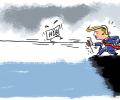
'If you are so blinded by the Buy American, Hire American policy, if you are not going to be fair, consistent and welcoming, in the end America will lose out.'
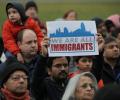
"Removing H-4 Dependent Spouses From the Class of Aliens Eligible for Employment Authorisation," said the US department of homeland security's unified agenda in the federal register notification of its semi-annual regulatory agenda.

The denial rate jumped from 4% to 41% for Tech Mahindra, from 6% to 34% for TCS, from 7% to 53% for Wipro and from just 2% to 45% for Infosys.
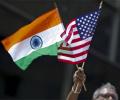
In a big relief for thousands of stranded Indian professionals in America due to the coronavirus pandemic, the US government has decided to allow applications by H-1B visa holders for an extended stay in the country. The US department of homeland security in a new notification has said it recognises that there are immigration-related challenges as a direct result of the coronavirus pandemic.
H-4 is issued to the spouse of H-1B visa holders, a significantly large number of whom are high-skilled professionals from India.

The Biden administration on Friday issued a formal notification to delay the implementation of the previous Trump regime's controversial rule to raise mandatory minimum pay for foreign workers on H-1B visa, the most sought after among Indian IT professionals. The H-1B visa is a non-immigrant visa that allows US companies to employ foreign workers in specialty occupations that require theoretical or technical expertise. The technology companies depend on it to hire tens of thousands of employees each year from countries like India and China. The Department of Labour in its federal notification published on Friday said that it is considering whether to propose a further delay of the final rule's effective date and accompanying implementation periods that are currently scheduled to take effect on May 14, 2021, and July 1, 2021, respectively.
External Affairs Minister Sushma Swaraj told the Rajya Sabha that this is an issue of concern not just for the government and the Opposition, but the entire House and the nation shares this concern
The new information required by the Department of Labour is significant because before sponsoring a foreign worker for the H-1B visa, the company needs to get its labour application approved by it.
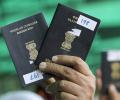
With Democrats having an upper hand in US Congress, the Donald Trump administration will find it difficult to come up with any future legislative changes with regard to visa regulations.
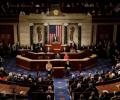
The proposals aims to impose new restrictions to prevent abuse and misuse of H-1B visas, besides ending the provision of granting extension for those who already have a green card.

H1-B holders in the US can rest assured that changes are soon coming which will bring both simplicity and certainty to your stay, including a potential path to citizenship: Trump.

Also looks at setting up development and training centres in the US to tide over visa-related issues
Amid headwinds across global markets, US issues fresh restrictions on H-1B visas. Ayan Pramanik & Raghu Krishnan list out the many ways in which this impacts the Indian IT industry.
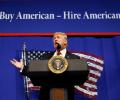
Amid hints that the government might be exploring capping royalty payments by India-based subsidiaries to US companies, experts warn Subhayan Chakraborty why such a move will only hurt the Indian economy.

To secure a work visa in the US, students have to find an employer who can sponsor it.

Trump to sign an executive order aimed at achieving a more skills-based and merit-based immigration system.

The futures of thousands of undocumented Indians who were taken to the US as children are in danger after Donald Trump's repeal of the DACA program.
